
It's 11 PM. Your calculus exam is in two days. The derivatives still don't make sense, your study group has gone quiet, and staring harder at the textbook is doing nothing. You snap a photo of the problem. Thirty seconds later, you don't just have the answer — you understand, step by step, exactly how to get there.
That scenario used to be a fantasy. In 2026, it's just another Tuesday night for over 5 million students using Solvely.ai.
But this isn't a story about a homework shortcut. It's about a fundamental shift in how students access understanding — and why the old model of academic support is quietly collapsing under its own weight.
The State of Student Learning in 2026
Before we dig into what Solvely does, it helps to understand the landscape it exists in — because the numbers are striking.
According to recent research, global student AI usage jumped from 66% in 2024 to 92% by 2025. A Harvard University physics study found that students working with AI tutors learned more than twice as much in less time compared to those in traditional active-learning classrooms. Meanwhile, 63% of teachers believe AI helps students achieve better grades, and nearly half of students who regularly use AI tools report measurable grade improvements.
The AI education market, valued at $7.57 billion in 2025, is projected to reach $112.3 billion by 2034. Put simply: AI-assisted learning isn't a fringe experiment anymore. It's the new infrastructure of education.
Yet most AI tools students reach for — general-purpose chatbots, basic math apps, search engines — weren't built for learning. They were built for answers. Solvely was built for something harder: understanding.
Why Traditional Academic Support Is Struggling
The tutoring industry hasn't changed much in decades. A student hits a wall. A tutor is scheduled. The tutor explains. The student may or may not retain it. Repeat.
That model has three crippling problems in 2026:
Cost. One-on-one tutoring typically runs $50–$100+ per hour. For families managing multiple subjects, multiple students, or tight budgets, that math doesn't work.
Availability. Understanding doesn't wait for Tuesday at 4 PM. The moment a concept clicks — or refuses to — is often at odd hours, mid-assignment, or during a self-study session.
Depth. Most quick-answer tools — whether a classmate, a forum post, or a generic AI — hand over the answer without the reasoning. That approach might complete one assignment. It doesn't prepare students for the next one, or for the exam.
The result? Students fall back on copying solutions without internalizing them, or they give up on a topic entirely. Neither outcome serves anyone.
What Solvely.ai Actually Is
Solvely.ai, developed by Aignite Inc., is an AI-powered study companion available on iOS, Android, and web. Its core premise is simple: students should finish a study session understanding more, not just finishing faster.
To do that, it combines four capabilities that most competing tools handle separately — or not at all.
Core Features: A Closer Look
1. AI Photo Solver
The flagship feature. Point your phone camera at any problem — a textbook page, a handwritten worksheet, a whiteboard — and Solvely's AI returns a detailed, step-by-step solution within 10 to 30 seconds.
What separates this from a basic calculator or even Photomath is the reasoning layer. Each step comes with an explanation of why that step exists, what mathematical or scientific principle it applies, and how it connects to what comes next. For a calculus integration problem, you won't just see the answer — you'll follow the substitution, the intermediate logic, and the reasoning behind every move.
Accuracy sits around 90–95% for standard problems across math, physics, and chemistry. Printed text produces the most reliable results, though handwriting recognition has improved meaningfully in recent versions. Complex or poorly photographed problems occasionally drop below that range, which is worth keeping in mind for graduate-level or highly specialized coursework.
One important differentiator: while Photomath covers math only, Solvely extends photo solving across biology, economics, and select social science subjects — making it practical for the multi-subject reality of most students' lives.
2. 24/7 AI Tutor
Beyond solving individual problems, Solvely includes a conversational AI tutor — a genuine back-and-forth system, not just a static explainer. Students can ask follow-up questions, request a different explanation approach, probe a specific step they don't understand, or ask how a concept connects to something they learned last week.
The tutor is powered by a combination of AI models, including GPT-4 for complex problem-solving and Anthropic's Claude for humanities, social sciences, and conceptual reasoning. The multi-model approach serves a practical purpose: cross-checking answers before they reach the student, which contributes to the platform's accuracy advantage over single-model alternatives.
This is where Solvely's "learning-first" positioning becomes most tangible. The AI Tutor doesn't just respond — it probes back. Ask about a formula, and it may ask what you already know about the concept. That Socratic nudge is the difference between being told an answer and building the reasoning yourself.
3. AI Live Notes
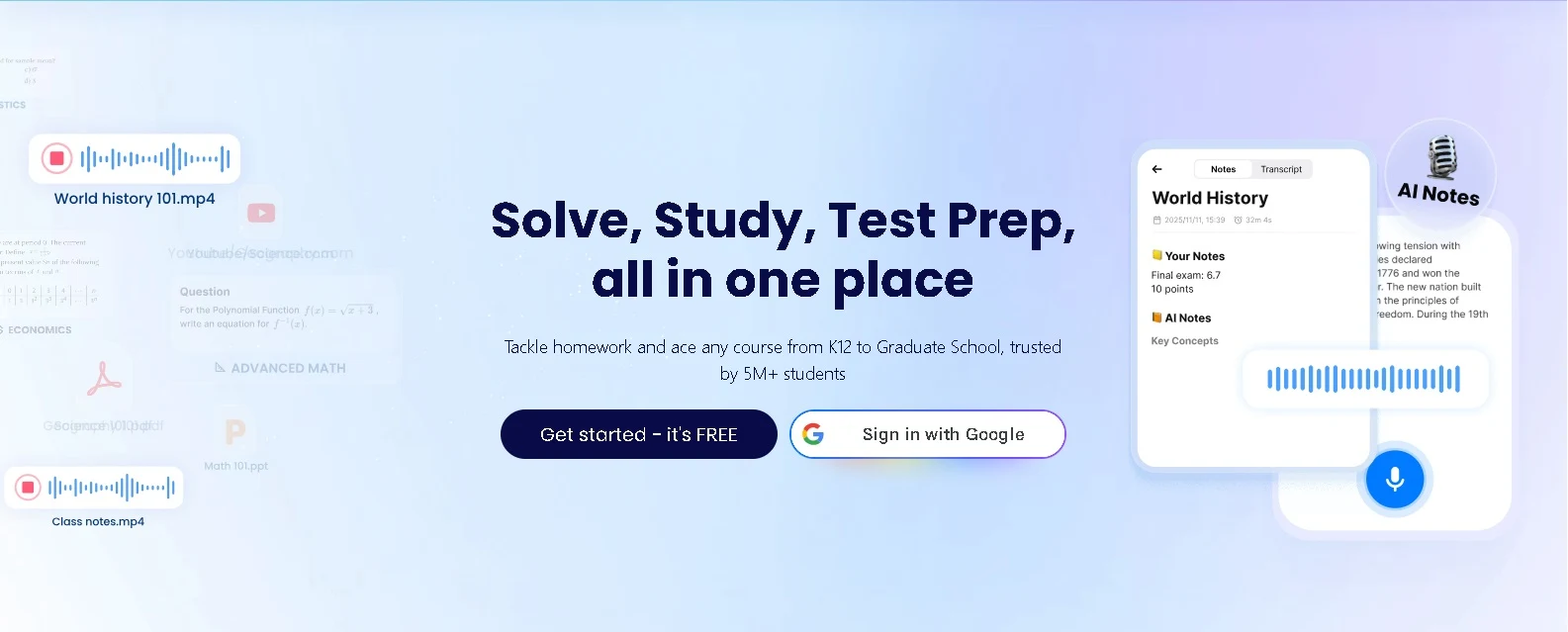
One of Solvely's most underrated features: real-time transcription and summarization of lectures, study sessions, or recorded content.
The Live Notes system captures spoken content as it happens, then generates smart summaries that highlight key points, definitions, and concepts. Students can search within those summaries later, turning an hour-long lecture into a navigable reference document rather than a wall of notes they never revisit.
The Chrome extension extends this capability to YouTube tutorials and online courses — automatically generating timestamped summaries and chapter-level digests. For students managing heavy workloads across platforms like Canvas, Blackboard, and Google Docs, this integration is a meaningful time-saver.
4. Study Ecosystem Tools
Rounding out the platform: a quiz generator that builds practice tests directly from uploaded notes, a writing assistant for structuring outlines and citations, flashcard generation, and even podcast-style audio recaps for students who process content better by listening.
The most recent updates (version 5.1.2 as of early 2026) focus on faster performance, improved answer verification, and tighter LMS integration — reflecting a product that's actively maturing rather than coasting on its launch features.
Subject Coverage
Solvely is built for students across every stage of education, from elementary arithmetic to graduate-level coursework. Subject coverage includes:
STEM: Mathematics (all levels through advanced calculus and linear algebra), Physics, Chemistry, Biology, Statistics, Engineering basics
Liberal Arts & Social Sciences: English literature and composition, History, Economics (micro and macro), Psychology, Philosophy, Sociology
Test Preparation: SAT, ACT, AP exams, GRE, GMAT, and professional certification prep — including a dedicated ATI TEAS preparation module for nursing school entrance exams, launched in 2026.
How Solvely Compares to Alternatives in 2026
| Feature | Solvely.ai | Photomath | ChatGPT | Google Socratic | Microsoft Math Solver |
|---|---|---|---|---|---|
| Multi-Subject Support | ✅ Full | ❌ Math only | ✅ General | ✅ Basic | ❌ Math only |
| Step-by-Step Explanations | ✅ Detailed | ✅ Basic | ⚠️ Variable | ⚠️ Basic | ✅ Good |
| AI Tutor (Conversational) | ✅ Interactive | ❌ No | ⚠️ Basic | ❌ No | ❌ No |
| Live Note-Taking | ✅ Yes | ❌ No | ❌ No | ❌ No | ❌ No |
| LMS Integration | ✅ Yes | ❌ No | ❌ No | ❌ No | ❌ No |
| Accuracy Rate | ✅ 90–95% | ✅ 90%+ | ⚠️ 70–80% | ⚠️ 70–80% | ✅ ~90% |
| Offline Access | ❌ No | ⚠️ Partial | ❌ No | ❌ No | ❌ No |
| Pricing | Freemium | Freemium | Free/Paid | Free | Free |
Based on 2026 feature comparisons and published user testing.
The absence of offline mode remains Solvely's most notable functional gap. For students in areas with unreliable connectivity, or those who prefer studying without a live internet connection, this is a real limitation worth factoring in.
Pricing in 2026
Solvely runs a freemium model with three tiers:
Free Plan: 2 problem solves — enough to genuinely test the platform before committing.
Pay-As-You-Go (Gems): Starting at $0.99 for approximately 10 questions. Sensible for light or occasional users who don't need unlimited access.
Subscription Plans:
- Monthly: $12.99/month — full access including AI Tutor and Live Notes
- Annual: approximately $77/year (~$6.41/month) — best value, with early feature access and priority support
Note: Some third-party reviews have cited a slightly different annual figure (~$46.99/year for some promotional pricing). It's worth checking the current rate directly at Solvely.ai, as pricing has been updated across plans.
For context: a single hour with a private tutor typically costs more than a month of Solvely's subscription. If the platform helps a student genuinely understand one difficult concept — one that would otherwise require a tutoring session — it has more than covered its cost.
The Ethical Question: Is Using Solvely Cheating?
This is worth addressing directly, because it's the question most parents, educators, and students have in the back of their minds.
The short answer: it depends entirely on how you use it.
The longer answer: research increasingly suggests the concern about AI tools enabling cheating is real, but it's distinct from the concern about AI tools enabling learning. Both exist simultaneously. A 2026 OECD report on digital education found that general-purpose AI tools can enhance task performance without producing real learning gains — specifically when students outsource cognitive effort rather than engage with the AI as a teaching aid.
Solvely's design actively works against that pattern. The step-by-step explanations require students to follow reasoning, not just copy outputs. The AI Tutor prompts follow-up thinking. The quiz generator creates new problems from old material, making it harder to treat solutions as finished products.
That said, no tool can force genuine engagement. A student determined to copy answers can do so with Solvely just as easily as with any other resource. The platform's "Honor Code," posted on its website, frames the expectation clearly: Solvely is designed for learning, not for bypassing it.
For educators navigating this: the most forward-thinking approach isn't banning AI tools — it's designing assessments that require the kind of reasoning AI can explain but can't do for students.
Who Gets the Most from Solvely
Strongest fit:
- Students stuck on specific concepts outside of class hours
- Self-directed learners managing heavy multi-subject workloads
- Students preparing for standardized tests who need structured, on-demand review
- Parents who want to help their kids but don't have the subject knowledge themselves
- Adult learners returning to education after a gap
Weaker fit:
- Students who need intensive, personalized human mentorship or emotional support
- Graduate researchers working on highly specialized or novel academic problems
- Students whose learning style depends primarily on live discussion and debate
- Anyone without a reliable internet connection
The Bigger Picture: Where AI Education Is Heading
Solvely's trajectory reflects a broader shift in how education institutions and students are thinking about AI. The OECD's 2026 Digital Education Outlook draws a clear distinction between AI tools that perform tasks for students and AI tools that support students in performing tasks themselves. The report advocates strongly for the latter — and for tools designed with specific pedagogical goals rather than general-purpose utility.
By that standard, Solvely is better positioned than most of its competitors. Its multi-model architecture, subject breadth, and tutor integration reflect genuine investment in the learning side of the equation, not just the answer-delivery side.
What's coming next, based on development signals: deeper personalization that tracks individual learning patterns across sessions, expanded humanities coverage for more advanced literary and philosophical analysis, tighter integration with academic scheduling tools, and broader professional certification modules beyond the TEAS addition.
Final Verdict
Rating: 4.7 / 5
Solvely.ai in 2026 is one of the most complete AI study tools available — not because it does everything, but because what it does, it does with learning as the actual goal. The AI Photo Solver is genuinely accurate and genuinely explanatory. The AI Tutor goes deeper than a chatbot. The Live Notes feature fills a gap no competitor has meaningfully addressed.
The free tier is modest, and the lack of offline access will be a dealbreaker for some. Graduate-level or highly specialized academic work may push beyond its current capabilities.
But for the student in the middle of a difficult semester — across any subject, at any hour — Solvely delivers something that used to require either an expensive tutor or a patient, knowledgeable friend: a clear, reasoned explanation of what's actually going on.
That's worth something.
Getting Started
Step 1: Download the app (iOS / Android) or visit solvely.ai. Use your 2 free solves to test the photo solver on a real problem from your current coursework.
Step 2: If it works for your subject, try a conversation with the AI Tutor on a concept you've been fuzzy on. Notice whether it prompts you to think, or just tells you.
Step 3: For regular users, the annual plan offers the clearest value. Occasional users are better served by the pay-as-you-go Gems model.
Promotional code: Use AIBYTES at checkout for up to 20% off annual subscriptions, plus a 30-day money-back guarantee.
Disclosure: This article contains affiliate links. All features and pricing reflect information available as of March 2026 and are subject to change. This review is based on independent testing, published user feedback, and publicly available product documentation.