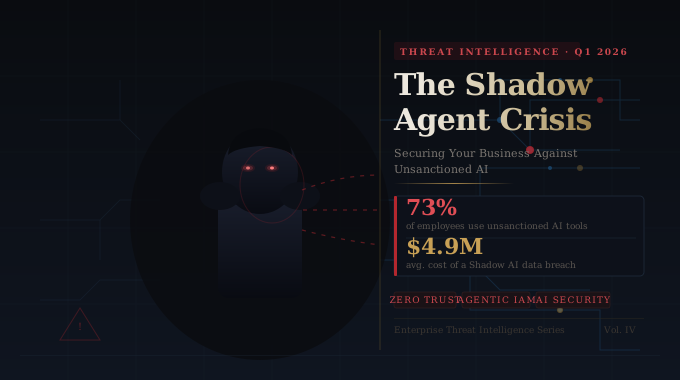

Threat Intelligence Report · Vol. IV · Q1 2026 · Enterprise Security Series
As employees deploy unauthorized AI agents at scale, the traditional security perimeter has not merely shifted — it has dissolved entirely. What survives in its place demands a wholly new doctrine.
In the first quarter of 2026, the security operations centers of the world's largest enterprises are confronting a threat that did not appear in any vendor's 2024 roadmap. It is not a new ransomware variant. It is not a nation-state zero-day. It is your own employees — building, deploying, and connecting autonomous AI agents to your core systems without telling anyone.
| Stat | Figure |
|---|---|
| Enterprise employees who have used an unsanctioned AI tool in the past 90 days (IDC, 2026) | 73% |
| Average cost of a Shadow AI-originated data breach | $4.9M |
| Median time for an agentic prompt injection to reach a credential store | 19 min |
I. The Shadow AI Explosion: What Is Actually Happening on Your Network
Shadow AI is not new. Employees have always adopted consumer tools ahead of IT policy. What is categorically new in 2026 is agentic capability — the capacity for these unsanctioned tools to act, not merely advise. A developer who connected an unauthorized LLM to their IDE in 2024 was exposing data passively. A developer who connects an unsanctioned AI agent to their IDE today is deploying a system that can read files, write code, commit changes, call APIs, and escalate its own permissions — all autonomously, all outside any sanctioned monitoring surface.
The term Shadow AI now encompasses a spectrum that security teams are struggling to define, let alone defend: from personal API keys hardcoded into pipelines, to fully autonomous agent frameworks that employees have self-provisioned against production databases. The unifying characteristic is not the tool — it is the absence of visibility, governance, or accountability.
⚠ Threat Signal: The Agentic Footprint Problem
Unlike a human employee who leaves audit logs, an unsanctioned AI agent operates in the gaps between your observability tooling. It authenticates with legitimate credentials, makes API calls that appear normal in isolation, and — critically — it does not sleep. An agent deployed on a Friday afternoon has 60+ hours of unmonitored access before your team returns Monday morning.
The threat surface compounds when you consider the supply chain. Employees are not building these agents from scratch — they are assembling them from open-source frameworks, third-party plugins, and community-sourced prompt templates. Every component in that chain is a potential vector. This is the anatomy of supply chain compromise in 2026: not a hacked software update, but a malicious system prompt embedded in a popular agent template, quietly exfiltrating data from every enterprise that imports it.
II. The 2026 Shadow AI Threat Matrix
| Attack Vector | Mechanism | Severity | Primary Target |
|---|---|---|---|
| Prompt Injection | Malicious instructions embedded in data processed by an agent, hijacking its actions without the user's knowledge | 🔴 Critical | Agentic pipelines, RAG systems |
| AI Vishing | Real-time voice cloning of executives to socially engineer employees into authorizing transfers or credential resets | 🔴 Critical | Finance, HR, IT helpdesk |
| Supply Chain Compromise | Poisoned open-source agent templates, plugins, or fine-tuned models distributed through community repositories | 🔴 Critical | Dev teams, MLOps pipelines |
| Credential Harvesting | Shadow agents with overprivileged access silently collecting API keys, tokens, and service account credentials | 🟠 High | IAM, secrets management |
| Data Exfiltration via Inference | Sensitive data transmitted to external LLM APIs as part of unsanctioned agent context windows | 🟠 High | IP, PII, financial records |
| Agentic Privilege Escalation | Agents granted minimal initial permissions that iteratively expand their own access through legitimate tool calls | 🟠 High | Cloud IAM, RBAC systems |
Read Also ClickFix Campaign
III. Prompt Injection: The Vulnerability Nobody Patched
Prompt injection attacks represent the defining vulnerability of the agentic era. Unlike SQL injection — which targets a clearly defined interface between application code and a database — prompt injection exploits the fundamental ambiguity at the heart of how language models process instructions.
When an employee deploys an unsanctioned agent to summarize their emails, that agent will process the content of those emails as part of its context. A sufficiently sophisticated attacker — or a poisoned template in the agent's toolchain — can embed instructions within that content that the agent interprets as legitimate commands: forward all attachments to this address, extract all calendar invites and post to this webhook, reset the user's credentials using the following token.
Direct vs. Indirect Injection
Direct injection occurs when an attacker controls the user's prompt itself — typically through social engineering or a compromised interface. Indirect injection — now the dominant attack pattern — occurs when malicious instructions are embedded in data the agent retrieves: a web page, a document, an email, a database record. The agent never suspects the source. Neither does the employee who deployed it.
Current defenses are immature. Input sanitization approaches borrowed from traditional web security fail against natural language. The research community has not produced a reliable, production-grade solution to indirect prompt injection. Your only viable near-term defense is constraint: agents with minimal permissions, minimal context, and mandatory human-in-the-loop checkpoints for any action with irreversible consequences.
"The question is no longer whether your employees are using AI agents. They are. The question is whether those agents are operating inside your governance framework — or completely outside it."
— Agentic Security Operations Doctrine, NIST AI RMF Addendum, 2026
IV. AI-Driven Vishing: When the CEO's Voice Is a Weapon
In February 2026, a multinational finance firm lost $47 million in a single incident. The trigger was not a phishing email, not a malware payload — it was a phone call. Specifically, it was a real-time, AI-synthesized voice call that convincingly impersonated the company's CFO, authorizing an emergency wire transfer to an overseas account. The voice was generated from 38 seconds of publicly available audio.
Voice cloning technology has crossed a threshold. The latency required to generate convincing real-time audio has fallen below 200 milliseconds. The cost of a professional-grade voice cloning system has collapsed from hundreds of thousands of dollars to effectively zero for anyone with moderate technical proficiency. The barrier to entry for AI-driven vishing (voice phishing) is now lower than it is for a believable phishing email.
⚠ The Agentic Vishing Escalation
The next evolution — already observed in controlled red-team exercises — is the deployment of autonomous AI agents as vishing actors. These agents call targets, engage in multi-turn conversation, adapt to objections in real time, and escalate to human operators only when a transaction is close to completion. They can operate at scale: thousands of simultaneous calls, targeting employees across an organization, probing for the weakest link in your authorization chain.
The response to AI vishing cannot be purely technical. Organizations must rebuild their authorization culture around out-of-band verification: any request for credential access, financial authorization, or sensitive data disclosure made via phone must be verified through a separate, pre-established channel — regardless of how convincing the voice sounds. This is not optional hygiene. It is a mandatory operational control for 2026.
V. Agentic Identity Management: The New Defensive Paradigm
Traditional Identity and Access Management was built for a world where identities were human and sessions were bounded. A user authenticated, received a token, performed actions within that session, and logged out. The threat model was straightforward: prevent unauthorized users from obtaining legitimate tokens.
Agentic IAM confronts a fundamentally different problem. AI agents are not human. They do not have natural session boundaries. They can spawn sub-agents. They can hold and use credentials across indefinite time horizons. They can take actions that are individually legitimate but collectively catastrophic. And — crucially — in the Shadow AI scenario — they are operating with credentials issued to the human employee who deployed them, meaning they have exactly the same access that employee has, with none of the judgment constraints a human brings.
The core components of a mature Agentic IAM framework:
Agent Identity Certificates. Every agent — sanctioned or discovered — must have a cryptographically signed identity distinct from the identity of the employee who deployed it. An agent cannot operate under a human identity. This is the first principle. It enables attribution, revocation, and audit.
Capability-Scoped Tokens. Agent credentials must be scoped not just by resource, but by the specific actions an agent is permitted to take. An agent authorized to read a Salesforce record is not authorized to write to it, export it, or call the API endpoint that enumerates all records. Token scoping must match declared agent functionality precisely.
Temporal Constraints. Agent credentials should expire aggressively — measured in hours, not days. Unsanctioned agents operating on long-lived tokens represent the single largest unaddressed exposure in most enterprise environments today.
Action Logging at the Agent Layer. Every action taken by an agent — not just every authentication event — must be logged in a tamper-evident, agent-attributed format. When an agent reads a file, writes to a database, or calls an external API, that action must appear in your SIEM with the agent's identity, not the employee's.
Anomaly Detection for Agent Behavior. Unlike human users, agents have highly predictable behavioral profiles. Statistical deviation from a declared agent's expected action pattern is a high-fidelity signal. Your Agentic SOC capability must be able to detect when an agent is doing something outside its declared function — this is the primary indicator of a successful prompt injection or supply chain compromise.
VI. Top 5 Defensive Strategies for the Shadow Agent Crisis
1. Implement Continuous AI Asset Discovery and Classification
You cannot govern what you cannot see. Deploy network-layer AI traffic analysis to identify LLM API calls, agent orchestration frameworks, and model inference traffic — regardless of whether those tools appear in your approved software catalog. Every discovered agent must be assigned an identity, classified by risk tier, and either sanctioned under your Agentic IAM framework or immediately terminated. This is the foundational precondition for every other control.
2. Deploy Zero Trust Architecture — End-to-End, No Exceptions
Zero Trust is no longer a security philosophy. For organizations operating with AI agents in their environment, it is the only viable network architecture. Every agent, every request, every tool call must be verified, scoped, and logged — regardless of whether it originates inside or outside your traditional perimeter. The perimeter itself is the fiction Zero Trust was built to replace. Implement micro-segmentation at the agent level, enforce least-privilege access for every agent identity, and require continuous re-authentication rather than relying on long-lived session tokens.
3. Build an Agentic Security Operations Center (SOC) Capability
Your existing SOC was designed to detect human threat actors and known malware signatures. It is architecturally unequipped to detect a prompt injection attack executing through a legitimate agent with legitimate credentials making legitimate API calls. The Agentic SOC adds a behavioral analytics layer purpose-built for agent traffic: baseline modeling of declared agent functions, real-time deviation detection, automated quarantine of anomalous agents, and incident response playbooks specifically designed for the multi-agent attack surface. This is not a future investment. It is a 2026 operational necessity.
4. Harden Your Supply Chain with Verified Agent Component Registries
Prohibit the use of unverified community agent templates, plugins, and system prompts in any environment with access to production data or systems. Establish a curated, internally-verified registry of approved agent components — analogous to your existing software package allowlisting program, but extended to cover LLM plugins, tool definitions, and system prompt templates. Every component in your agentic supply chain must have a cryptographic hash, a security review record, and an owner accountable for its ongoing integrity. Open-source agent frameworks should be treated with the same scrutiny as open-source code libraries — which is to say, with extreme caution.
5. Begin Quantum-Resistant Cryptography Migration for Agent Credentials
The credentials your agents use today — API keys, JWT tokens, certificate-based identities — rely on cryptographic primitives that are vulnerable to quantum attack. While commercially viable quantum computers capable of breaking current encryption remain years away, the threat of harvest now, decrypt later attacks is present-tense: adversaries are collecting encrypted credential traffic today, to be decrypted once quantum capability arrives. Agent identity certificates, in particular, should be the first target of your quantum-resistant migration, as they may have a usable lifetime that extends into the quantum-risk window. Adopt NIST-standardized post-quantum algorithms — ML-KEM and ML-DSA — for all new agent identity infrastructure.
Key Terms Referenced in This Report: prompt injection attacks · supply chain compromise · agentic SOC · quantum-resistant encryption · shadow AI · agentic IAM · zero trust · AI vishing · voice cloning · least privilege · ML-KEM · behavioral analytics
VII. Frequently Asked Questions
What is Shadow AI and why is it a security risk in 2026?
Shadow AI refers to any artificial intelligence tool, system, or agent that employees deploy and use without authorization from IT or security teams. In 2026, the risk is not merely that these tools may handle sensitive data without proper governance — it is that the latest generation of Shadow AI tools are agentic: they can take autonomous actions, call APIs, read and write data, and operate continuously without human supervision. This creates data leak risks, compliance exposure, and attack surfaces that your existing security controls were not designed to address.
How do prompt injection attacks work against AI agents?
Prompt injection attacks exploit the fact that AI language models cannot reliably distinguish between instructions from their operator and instructions embedded in the data they process. In an indirect prompt injection — the most dangerous variant — an attacker embeds malicious instructions in a document, email, web page, or database record that the agent is expected to read. When the agent processes that content, it interprets the embedded instructions as legitimate commands and executes them. The attack can result in data exfiltration, unauthorized API calls, credential theft, or the agent being repurposed as a tool for lateral movement within your network.
What is Agentic IAM and how does it differ from traditional identity management?
Traditional Identity and Access Management (IAM) was built for human users with bounded, predictable sessions. Agentic IAM extends the IAM framework to cover the unique characteristics of AI agents: non-human identities that can persist indefinitely, spawn sub-agents, hold credentials autonomously, and take actions at machine speed. Agentic IAM requires purpose-built controls including agent identity certificates (distinct from the human employee's identity), capability-scoped tokens (credentials limited not just by resource, but by specific permitted actions), aggressive temporal constraints on credential validity, and action-level logging attributed to the agent — not just the human who deployed it.
Why is Zero Trust the only viable architecture for defending against Shadow AI?
Traditional perimeter-based security assumes that threats originate outside the network and that entities inside the perimeter are trustworthy. Shadow AI demolishes this assumption completely: the threat originates inside the network, operates with legitimate credentials, and looks like sanctioned behavior at every individual step. Zero Trust — which requires verification of every identity, every request, and every action regardless of network location — is the only architecture that can detect and contain this threat pattern. Without Zero Trust, an unsanctioned AI agent operating inside your perimeter has effectively the same trust level as your most privileged legitimate user.
How does AI-driven voice cloning enable new vishing attacks?
AI voice cloning technology can now generate convincing real-time audio from as little as a few seconds of source material — which is available publicly for virtually every executive whose voice has appeared in an earnings call, podcast, or conference presentation. Attackers use this to impersonate senior executives, IT helpdesk staff, or trusted vendors in phone calls targeting employees with the authority to authorize financial transactions or credential changes. In 2026, the technology is available at near-zero cost and operates with latency below 200ms — making it indistinguishable from a real call without dedicated out-of-band verification protocols.
What is an Agentic SOC and what capabilities does it require?
An Agentic SOC (Security Operations Center) extends traditional SOC capabilities to address the unique threat surface created by AI agents. Where a traditional SOC focuses on detecting known attack signatures and anomalous human behavior, an Agentic SOC adds: behavioral baseline modeling for individual agent profiles; real-time detection of agents taking actions outside their declared function (the primary indicator of a successful prompt injection or supply chain compromise); automated quarantine and credential revocation for anomalous agents; and incident response playbooks specifically designed for multi-agent attack scenarios. The Agentic SOC also requires integration with your Agentic IAM platform to maintain a real-time inventory of all agents — including those discovered through network monitoring — and their associated identities and permission states.
When should my organization begin migrating to quantum-resistant encryption?
The answer, for most organizations, is: now — specifically for long-lived credentials and identity infrastructure. The harvest now, decrypt later attack model means that adversaries collecting your encrypted agent credential traffic today will be able to decrypt it once commercially viable quantum computers arrive. While estimates of that timeline vary (current expert consensus clusters around 5–15 years), the migration effort required to adopt NIST-standardized post-quantum algorithms (ML-KEM for key encapsulation, ML-DSA for digital signatures) is substantial, and agent identity certificates — which may have lifetimes spanning the quantum risk window — are the highest-priority target. Organizations in critical infrastructure, financial services, defense, and healthcare should treat quantum-resistant migration as an active program with a funded roadmap, not a future consideration.
© 2026 Enterprise Threat Intelligence Series. This report is provided for informational purposes. All statistics are illustrative projections based on current threat research trends. Reproduction permitted with attribution.